
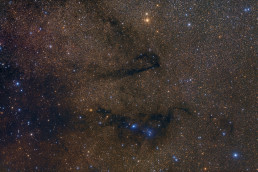
vdB 126 in Vulpecula
Details
Diese Nebelregion im Sternbild Vulpecula (Füchschen) wird oft als „Loch Ness Nebel“ bezeichnet, aufgrund der Ähnlichkeit des markanten Dunkelnebels mit dem vermeintlichen Monster von Loch Ness. Bei der Bildbearbeitung kam mir allerdings noch ein anderes Märchen in den Sinn: die Bremer Stadtmusikanten, mit dem Esel ganz unten, darüber Hund und Katze, und ganz oben thront der Hahn. Wenn ich behaupten würde, ich hätte den Bildausschnitt bewusst so gewählt, würde ich lügen. Geplant war lediglich, den hellen Stern Alpha Vulpeculae nicht an den Bildrand zu setzen, um Artefakte zu vermeiden. So entstand der Eindruck der übereinandergestapelten Tiere ganz von selbst.
Das zentrale Objekt der Aufnahme sind die beiden blauen Reflexionsnebel vdB 126, die auch unter den Bezeichnungen LBN 133 und LBN 134 bekannt sind. Sie liegen inmitten der opaken Dunkelwolken LDN 768, 769, 772 und 781. Beleuchtet wird vdB 126 vom Stern HD 182918 der Spektralklasse B.
Eine weitere Dunkelwolke erstreckt sich nördlich von vdB 126: LDN 779, 781, 782, 783 und 784.
Über den Dunkelwolken steht der hellste Stern des Sternbilds Füchschen, Alpha Vulpeculae, auch Anser genannt. Ein 4,44 mag heller Roter Riese der Spektralklasse M0. Noch etwas weiter oben leuchtet der schwächere Stern 8 Vulpeculae, ein 5,8 mag heller Stern der Spektralklasse K3 III.
Erwähnenswert sind außerdem die beiden offenen Sternhaufen NGC 6800 und NGC 6793, die jeweils am oberen und unteren Bildrand hineinragen, dort aber leider etwas angeschnitten sind.
English
This nebula region in the constellation Vulpecula (the Fox) is often called the „Loch Ness Nebula,“ named for the resemblance of its striking dark nebula to the supposed monster of Loch Ness. While processing the image, though, another fairy tale came to mind: the Bremen Town Musicians, with the donkey at the very bottom, the dog and cat above it, and the rooster perched on top. If I claimed I’d chosen this framing on purpose, I’d be lying. The only real plan was to keep the bright star Alpha Vulpeculae away from the edge of the frame to avoid artifacts. The impression of stacked animals emerged entirely on its own.
The central objects in this image are the two blue reflection nebulae of vdB 126, also catalogued as LBN 133 and LBN 134. They sit embedded within the opaque dark clouds LDN 768, 769, 772, and 781. vdB 126 is illuminated by the star HD 182918, a spectral type B star.
Another dark cloud stretches north of vdB 126: LDN 779, 781, 782, 783, and 784.
Above the dark nebulae shines the brightest star in Vulpecula, Alpha Vulpeculae, also known as Anser, a magnitude 4.44 red giant of spectral type M0. A little further up glows the fainter star 8 Vulpeculae, a magnitude 5.8 star of spectral type K3 III.
Also worth mentioning are the two open clusters NGC 6800 and NGC 6793, which reach into the frame at the top and bottom, though unfortunately both are slightly cropped.
Image Details
Telescope Optics
Takahashi Epsilon 130D
Mount
ZWO AM5
Camera
ZWO ASI2400MC pro
Filters
Bayer Matrix
Integration Time
105 x 300s RGB
Date
11th to 13th of August 2026
Conditions
Good Sky Conditions
Remarks
Object Details
Type of Object
Dark Nebula
Constellation
Vulpecula
Location
Sauerland, Germany