
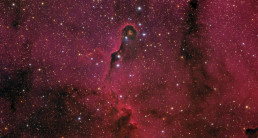
Elefantenrüsselnebel (IC 1396A)
Details
Der Elefantenrüsselnebel, oder genauer gesagt IC1396A, ist eine sogenannte kometare Globule. Solche Dunkelnebelfinger entstehen am Rand von Sternentstehungsregionen, in diesem Fall am Rand des Gasnebels IC 1396. Im Zentrum dieses Gasnebels (hier nicht im Bild) steht der blaue O-Typ-Stern HD 206267, der mit seiner UV-Strahlung die gesamte Nebelregion zum Leuchten anregt.
Am Rand dieser Gashülle werden Gas und Staub des Nebels verdichtet, wodurch sogenannte Bright Rims entstehen, zu Deutsch etwa „helle Ränder“. Man erkennt hier sehr deutlich, dass die hellen, im Licht des Wasserstoffs leuchtenden Ränder der Dunkelwolke zum Zentrum des Nebels und damit zu ihrer Ionisationsquelle hin ausgerichtet sind. Eine weitere, sehr bekannte Struktur dieser Art zeigt sich im Pferdekopfnebel.
(Dieser Abschnitt basiert auf dem Text zu IC 1396 im Buch „Bildatlas der Sternhaufen und Nebel“ von Michael König & Stefan Binnewies.)
Diese Aufnahme entstand mit einem vergleichsweise kleinen Teleskop, dem Takahashi FSQ-106ED. Durch den kleinen Chip der ToupTek ATR585M entsteht der Eindruck eines viel größeren Teleskops. Die feine Abtastung durch die kleinen Pixel am Apo und die daraus resultierende Auflösung verstärken diesen Effekt zusätzlich.
Die Aufnahme des Bildes ist teilweise in einem meiner YouTube Videos dokumentiert.
The Elephant’s Trunk Nebula, or more precisely IC 1396A, is what’s known as a cometary globule. These dark-nebula „fingers“ form at the edge of star-forming regions, n this case, at the edge of the emission nebula IC 1396. At the center of this nebula (not visible in this image) sits the blue O-type star HD 206267, whose UV radiation excites the entire nebular region to glow.
At the edge of this gas shell, the nebula’s gas and dust are compressed, giving rise to so-called bright rims. You can clearly see here that the bright, hydrogen-glowing rims of the dark cloud face toward the center of the nebula, and thus toward their source of ionization. Another well-known example of this kind of structure can be seen in the Horsehead Nebula.
(This section is based on the text on IC 1396 in the book „Bildatlas der Sternhaufen und Nebel“ by Michael König & Stefan Binnewies.)
This image was captured with a comparatively small telescope, the Takahashi FSQ-106ED. The small sensor of the ToupTek ATR585M creates the impression of a much larger telescope. The fine sampling from the small pixels on this apo refractor – and the resulting resolution – further reinforce this effect.
Image Details
Telescope Optics
Takahashi FSQ106-ED
Mount
EQ6-R pro
Camera
Touptek ATR585M
Filters
LRGB+Ha
Integration Time
120 x 120s L, 60 x 120s Ha, 30 x 120s RGB each
Date
13th of August to 14th of August 2026
Conditions
Very Good Sky Conditions
Remarks
Object Details
Type of Object
Emission Nebula, Dark Nebula
Constellation
Cepheus
Location
Sauerland, Germany