
Vela-Deepfield um d Velorum
Details
Vela Widefield
Wenn wir auf der Nordhalbkugel im Winter die Milchstraße verfolgen, so landen wir unweigerlich im Süden beim Sternbild Orion, weiter zum Großen Hund, und dann scheint die Milchstraße am Horizont zu verschwinden. Auf der Südhalbkugel wird es dann erst richtig spannend, denn in den Sternbildern Puppis und Vela geht die Milchstraße weiter und beinhaltet die wahrscheinlich dichteste Ansammlung von Objekten. Vergleichbar ist diese Region allenfalls noch mit der Nebelregion im Sternbild Schwan.
Zwei Superlative treffen im Sternbild Vela aufeinander: die größte zusammenhängende Nebelregion überhaupt in unserer Milchstraße (zumindest in ihrer Winkelausdehnung am Himmel) und der zweitgrößte Supernovaüberrest am Himmel. Die Nebelregion wird meist als Gum-Nebel bezeichnet, der SNR als Vela-Supernovarest.
Hier ist es nun buchstäblich so, dass man sein Teleskop samt Kamera irgendwohin orientieren kann und mit einer Vielzahl von Objekten belohnt wird. In dieser Aufnahme befinden sich unzählige Objekte, deren ausführliche Recherche mich mehrere Tage gekostet hätte — von daher nur die bekanntesten:
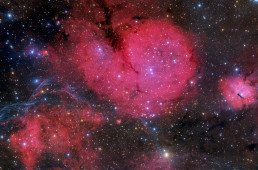
Das große rote Etwas im Zentrum des Bildes ist RCW 33. Gleich daneben der deutlich kleinere Gasnebel RCW 32, auch bekannt als Gum 15 (den ich hier im Detail fotografiert habe). Namensgeber dieses Bildes ist der Stern d Velorum, der hier am unteren Bildrand gelblich leuchtet. Etwas nördlich von d Velorum liegt ein offener und sehr lockerer Sternhaufen, Trumpler 10. Wesentlich kompakter und gelblich leuchtend ist NGC 2671, der offene Sternhaufen westlich von Trumpler 10.
Unzählige diffuse Dunkel- und Reflexionsnebel ziehen sich durchs Bild, einige davon im van-den-Bergh-Herbst-Verzeichnis katalogisiert wie etwa VdBH 25a B und VdBH 25g. Ein weiterer Reflexionsnebel ist GN 08.55.8. Und zu guter Letzt natürlich die vielen, zarten blau und rot leuchtenden Filamente des Vela-Supernovarests.
Vela Widefield
When we follow the Milky Way on the northern hemisphere in winter, we inevitably head south to the constellation of Orion, on to Canis Major, and then the Milky Way seems to vanish at the horizon. On the southern hemisphere is where it really gets exciting, because in the constellations of Puppis and Vela the Milky Way continues and holds what is probably the densest concentration of objects anywhere. The only region that comes close is the nebula complex in the constellation of Cygnus.
Two superlatives meet in the constellation of Vela: the largest contiguous nebula region in our Milky Way (at least in terms of its angular extent on the sky) and the second-largest supernova remnant in the sky. The nebula region is usually referred to as the Gum Nebula, the remnant as the Vela Supernova Remnant.
Here it is quite literally the case that you can point your telescope and camera just about anywhere and be rewarded with a wealth of objects. This image contains countless objects whose thorough research would have taken me several days — so here are just the best-known ones:
The large red something at the centre of the image is RCW 33. Right beside it is the considerably smaller gas nebula RCW 32, also known as Gum 15 (which I have photographed in detail here). The image takes its name from the star d Velorum, glowing yellowish at the bottom edge here. Slightly north of d Velorum lies an open and very loose star cluster, Trumpler 10. Much more compact and glowing yellowish is NGC 2671, the open cluster west of Trumpler 10.
Countless diffuse dark and reflection nebulae run across the image, some of them catalogued in the van den Bergh–Herbst catalogue, such as VdBH 25a B and VdBH 25g. Another reflection nebula is GN 08.55.8. And last but not least, of course, the many delicate blue and red glowing filaments of the Vela Supernova Remnant.
Image Details
Telescope Optics
Skywatcher ESPRIT100
Mount
Skywatcher EQ6-R pro
Camera
ZWO ASI2400MC pro
Filters
NO
Integration Time
113 x 300s
Date
6th to 9th of may 2026
Conditions
Excellent Sky Conditions
Remarks
Object Details
Type of Object
Emission Nebula
Constellation
Vela
Location
Kiripotib Guestfarm, Namibia