
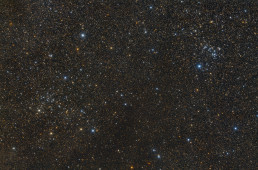
IC 4756 & NGC 6633
Details
IC 4756 und NGC 6633 – zwei offene Sternhaufen an der Grenze von Schlange und Schlangenträger
IC 4756 und NGC 6633 sind zwei offene Sternhaufen, die am Himmel nur rund drei Grad auseinanderstehen. IC 4756, hier links im Bild, steht im Sternbild Serpens (Schlange), NGC 6633 im Sternbild Ophiuchus (Schlangenträger). Beide Sternhaufen stehen etwas westlich des Aquila Rifts, einer großen Dunkelwolke, die das Band der Milchstraße in diesem Bereich teilt. Mit einer scheinbaren Helligkeit von jeweils etwa 4,6 mag kann man beide Haufen unter guten Bedingungen bereits mit bloßem Auge sehen.
Auch räumlich sind die beiden Nachbarn: NGC 6633 ist rund 1.300 Lichtjahre (etwa 400 Parsec) entfernt, IC 4756 etwa 1.570 Lichtjahre (rund 480 Parsec).
IC 4756 ist lockerer verteilt und in der Ausdehnung größer, wohingegen NGC 6633 kompakter erscheint und auch etwas heller. In der Aufnahme erkennt man außerdem, dass NGC 6633 der jüngere Haufen ist und mehr blaue Sterne enthält. Es sind zwar nicht sehr viele dieser blauen Sterne, aber aufgrund ihrer Helligkeit bestimmen sie den farblichen Gesamteindruck des Haufens. Der Altersunterschied ist gut belegt: NGC 6633 ist nach einer aktuellen Studie auf Basis von Asteroseismologie und Gaia-Daten etwa 550 Millionen Jahre alt, IC 4756 mit rund 800 bis 900 Millionen Jahren deutlich älter. Bei diesem Alter haben die massereichsten blauen Sterne die Hauptreihe bereits verlassen, weshalb IC 4756 insgesamt gelblicher wirkt.
Das Band der Milchstraße ist in diesem Bereich deutlich gerötet durch vorgelagerten Staub. Eine dichtere Staubwolke ragt von unten keilförmig ins Bild: die Dunkelwolke TGU H322 P1 aus dem Dobashi-Atlas von 2005. Dieser Vordergrundstaub gehört zum Umfeld des Aquila-Rift-Komplexes und liegt mit geschätzten 230 Parsec deutlich vor beiden Sternhaufen.
Das Bild entstand in zwei Sommernächten im Juli 2026, nachdem ich die Region zuvor in meiner monatlichen Himmelsvorschau für Astrofotografen vorgestellt hatte.
YouTube Video
IC 4756 and NGC 6633 – Two Open Star Clusters on the Border of Serpens and Ophiuchus
IC 4756 and NGC 6633 are two open star clusters separated by only about three degrees in the sky. IC 4756, here on the left side of the image, lies in the constellation Serpens (the Serpent), NGC 6633 in the constellation Ophiuchus (the Serpent Bearer). Both clusters sit slightly west of the Aquila Rift, a large dark cloud that divides the band of the Milky Way in this region. With an apparent magnitude of about 4.6 each, both clusters can be seen with the naked eye under good conditions.
The two are also neighbors in space: NGC 6633 is about 1,300 light-years (roughly 400 parsecs) away, IC 4756 about 1,570 light-years (roughly 480 parsecs).
IC 4756 is more loosely scattered and larger in extent, whereas NGC 6633 appears more compact and also somewhat brighter. The image also reveals that NGC 6633 is the younger cluster and contains more blue stars. There aren’t very many of these blue stars, but due to their brightness they dominate the overall color impression of the cluster. The age difference is well established: according to a recent study based on asteroseismology and Gaia data, NGC 6633 is about 550 million years old, while IC 4756 is considerably older at around 800 to 900 million years. At that age, the most massive blue stars have already left the main sequence, which is why IC 4756 appears more yellowish overall.
The band of the Milky Way is noticeably reddened in this region by foreground dust. A denser dust cloud juts into the image from below in a wedge-like shape: the dark nebula TGU H322 P1 from the 2005 Dobashi atlas. This foreground dust belongs to the wider Aquila Rift complex and, at an estimated 230 parsecs, lies well in front of both star clusters.
The image was taken over two summer nights in July 2026, after I had featured the region in my monthly sky preview for astrophotographers.
Image Details
Telescope Optics
Takahashi Epsilon 130D
Mount
ZWO AM5
Camera
ZWO ASI2400MC pro
Filters
Bayer Matrix DuoNarrowband
Integration Time
157 x 120 RGB
Date
11th to 13th of July 2026
Conditions
Good Sky Conditions
Remarks
Object Details
Type of Object
Open Cluster
Constellation
Serpens/Ophiuchus
Location
Eifel and Sauerland, Germany