
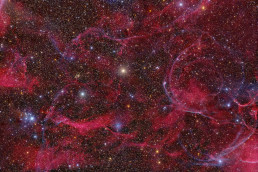
Vela SNR & IC 2395
Details
Vela SNR in Breitbandig
Der Vela-Supernovaüberrest, auch Vela SNR genannt, wird sehr häufig mit Schmalbandfiltern fotografiert. Die Stoßfront der Supernova breitet sich durch den Raum aus und trifft dabei auf das interstellare Medium. Das Gas wird erhitzt und ionisiert und beginnt zu leuchten. Besonders auffällig sind die blau leuchtende Emission von [O III] sowie die roten Strukturen des Hα-Lichts. Natürlich erreicht man mit entsprechend schmalbandigen Filtern den höchsten Kontrast und kann die feinsten Filamente des Supernovaüberrests besonders deutlich herausarbeiten.
Ich habe mich bei dieser Aufnahme jedoch bewusst dafür entschieden, diese Region im Breitband zu fotografieren. Eine solche Darstellung des Vela SNR sieht man deutlich seltener. Dadurch treten nicht nur die Nebelfilamente hervor, sondern auch das unglaublich dichte Sternfeld und zahlreiche weitere Deep-Sky-Objekte in dieser Region der südlichen Milchstraße.
In der annotierten Version erkennt man beinahe ein Dutzend offener Sternhaufen. Einige davon springen sofort ins Auge, wie etwa der auffällig blau leuchtende IC 2395, andere sind wesentlich unscheinbarer und finden sich beispielsweise in den Pismis-, FSR- oder ESO-Katalogen.
Besonders interessant sind die sehr unterschiedlichen Entfernungen der im Bild beteiligten Darsteller. Der Vela-Supernovaüberrest ist nur etwa 800 bis 1.000 Lichtjahre von uns entfernt, während IC 2395 bereits in einer Entfernung von ungefähr 2.300 bis 2.600 Lichtjahren liegt. Durch die hellen, blau leuchtenden Sterne des Sternhaufens entsteht im Bild fast der Eindruck, als läge IC 2395 vor den Filamenten des Supernovaüberrests. Tatsächlich ist es genau umgekehrt – hier täuscht also der visuelle Eindruck.
Zwei kleine Easter Eggs, die ebenfalls ins Netz gegangen sind, sind die planetarischen Nebel Hen 2-13 und LoTr 3.
Vela SNR in broadband
The Vela Supernova Remnant, also known as the Vela SNR, is very often photographed using narrowband filters. The expanding shock front of the supernova moves through space and interacts with the surrounding interstellar medium. The gas is heated and ionized, causing it to emit light. Particularly striking are the blue emission from [O III] and the red structures produced by H-alpha emission. Naturally, narrowband filters provide the highest contrast and reveal the extremely fine filaments of the supernova remnant particularly well.
For this image, however, I deliberately decided to photograph the region in broadband. Broadband images of the Vela SNR are seen much less frequently. This approach not only reveals the delicate nebular filaments, but also the incredibly rich stellar background and numerous additional deep-sky objects in this region of the southern Milky Way.
The annotated version shows nearly a dozen open star clusters. Some are immediately obvious, such as the striking blue cluster IC 2395, while others are much more inconspicuous and can be found in catalogues such as Pismis, FSR and ESO.
What makes the image particularly interesting is the very different distances of the objects visible within it. The Vela Supernova Remnant is only about 800 to 1,000 light-years away, while IC 2395 lies at a distance of approximately 2,300 to 2,600 light-years. Because of its bright blue stars, the cluster almost appears to lie in front of the glowing filaments of the supernova remnant. In reality, the opposite is true – the visual impression is misleading.
Two small Easter eggs that were also caught in the image are the planetary nebulae Hen 2-13 and LoTr 3.
Image Details
Telescope Optics
Skywatcher ESPRIT100
Mount
Skywatcher EQ6-R pro
Camera
ZWO ASI2400MC pro
Filters
NO
Integration Time
87 x 300s
Date
10th to 11th of May 2026
Conditions
Excellent Sky Conditions
Remarks
Object Details
Type of Object
Supernova, Open Cluster
Constellation
Vela
Location
Kiripotib Guestfarm, Namibia