
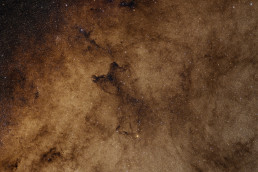
LDN 1795 & NGC 6451
Details
An den Stränden der Milchstraße
Südlich des sogenannten Bulges, also der zentralen Verdickung der Milchstraße, befindet sich eine enorm sternenreiche Region, die mit ihren goldenen Sternen an einen ausgedehnten Sandstrand erinnert. Während im zentralen Teil der Milchstraße dichte Wolken den Blick auf dahinterliegende Sterne verdecken, scheint die Sicht hier einigermaßen klar zu sein, und man sieht dementsprechend Millionen von Sternen.
Inmitten dieser dichten Sandbänke liegt wiederum ein Dunkelnebel, der mich von seinem Aussehen her an einen Elch oder an Höhlenmalereien erinnert. Es handelt sich um den Dunkelnebel LDN 1795 im Sternbild Skorpion.
Ebenfalls prominent im Bild ist der offene Sternhaufen NGC 6451 zu sehen. Für Astronomen ist es gar nicht leicht zu sagen, welche Sterne tatsächlich zu diesem Sternhaufen gehören und welche zu den unzähligen Sternen, die ohnehin in diesem Bereich der Milchstraße zu finden sind. Die Gaia-Mission ist hier eine wahre Goldgrube, und erst im Jahr 2024 erschien eine Studie von Raja et al., in der Gaia-Daten unter anderem von NGC 6451 mithilfe eines Machine-Learning-Algorithmus untersucht wurden.
On the shores of the Milkyway
South of the so-called Galactic Bulge, the central thickening of the Milky Way, lies an enormously star-rich region whose golden stars almost resemble an endless sandy beach. While dense clouds obscure our view of the stars behind them in the central parts of the Milky Way, the view here appears to be relatively clear, revealing millions of stars.
Amid these dense sandbanks lies yet another dark nebula, whose shape reminds me of an elk — or perhaps of an ancient cave painting. This is the dark nebula LDN 1795 in the constellation Scorpius.
Also prominently visible in the image is the open star cluster NGC 6451. For astronomers, it is not at all easy to determine which stars actually belong to the cluster and which are simply part of the countless stars already present in this extremely crowded region of the Milky Way. This is where the Gaia mission becomes a true gold mine. As recently as 2024, a study by Raja et al. used Gaia data to investigate NGC 6451, among other open clusters, with the help of a machine-learning algorithm.
Image Details
Telescope Optics
Skywatcher ESPRIT100
Mount
Skywatcher EQ6-R pro
Camera
ZWO ASI2400MC pro
Filters
NO
Integration Time
53 x 300s
Date
10th to 12th of May 2026
Conditions
Excellent Sky Conditions
Remarks
Object Details
Type of Object
Dark Nebula
Constellation
Scorpius
Location
Kiripotib Guestfarm, Namibia